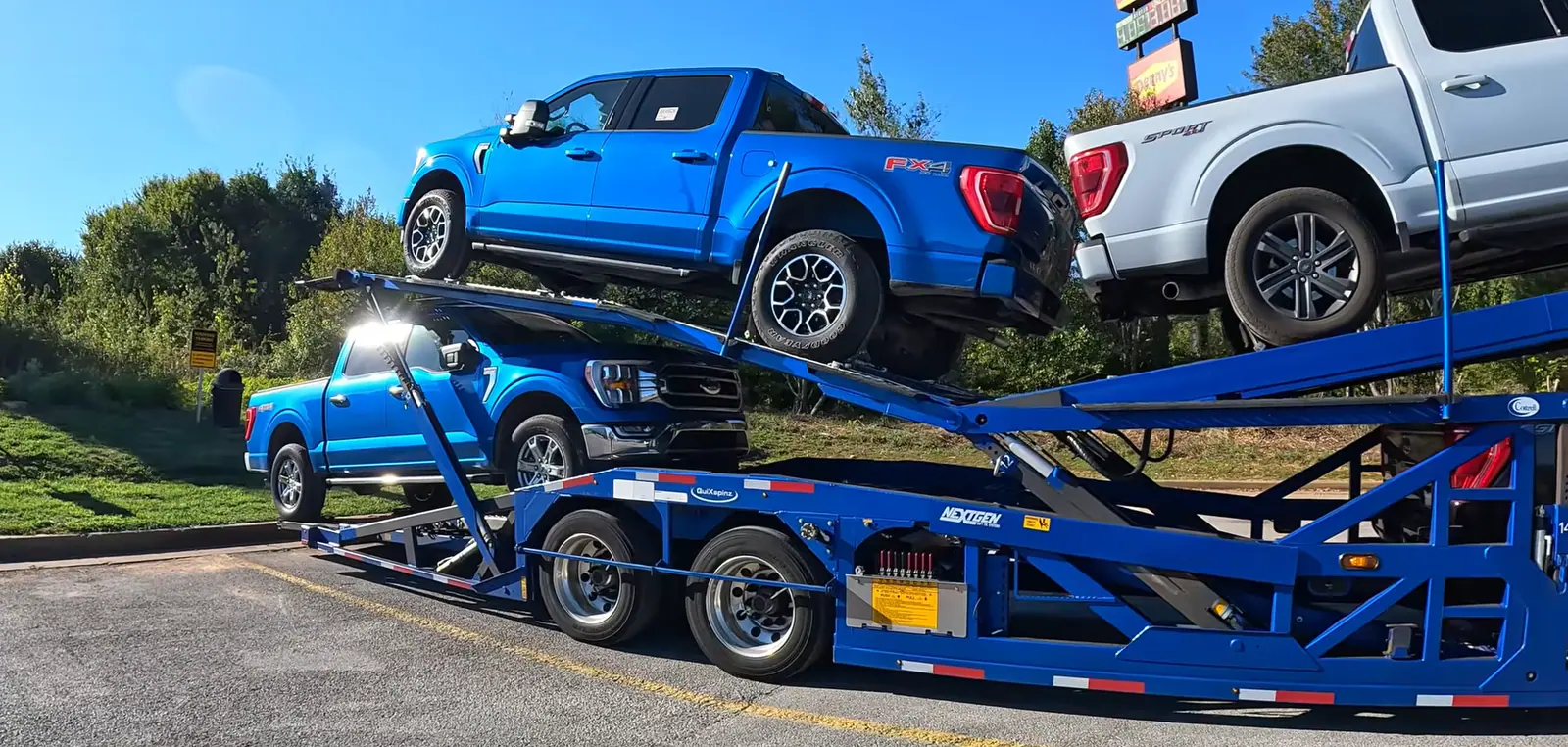
SUV and truck shipping
Big vehicles ship every day. The trick is describing yours accurately, so the truck that shows up has room for it.
Why size and weight matter more than the badge
An open car carrier is a puzzle of ramps and decks, and every slot has limits on length, height and weight. A compact crossover fits almost anywhere. A crew-cab, long-bed heavy-duty pickup can run past 20 feet and weigh more than two sedans, so it fits only in certain positions and uses up a lot of the truck's legal weight allowance. That's the whole story behind SUV and truck pricing: big vehicles take space that could have carried more than one car.
We arrange transport for the full range: Tahoes and Suburbans, Expeditions and Sequoias, half-ton pickups through three-quarter and one-ton diesels, lifted builds, and work trucks on their way to a new job. The more accurately you describe yours, the better the match.
How we book a big vehicle
Describe the truck, including what's been added
Year, make, model, cab and bed length, plus anything aftermarket: lift kit, oversized tires, roof rack, light bar, steel bumper, winch, toolbox. Each one changes the dimensions.
We find a slot that fits
Most stock SUVs and half-tons ride on standard open carriers. Lifted, extra-long or dual-rear-wheel trucks often go on the lower deck or on a smaller wedge or hotshot trailer pulled by a heavy-duty pickup, which has more flexibility on height and width.
Pickup and inspection
The driver checks the truck against what you described before loading. If the dimensions don't match, it may not fit the slot that was planned, so accurate details save a wasted trip.
Delivery
You inspect the vehicle against the pickup report, note anything new on the bill of lading, and sign. Check under the bumpers and along the running boards, which sit closest to the ramps.
What changes the price of shipping an SUV or pickup
| Factor | Why it matters |
|---|---|
| Length | Crew cabs and long beds take more deck than a regular cab with a short bed. Overall length is what the carrier plans around, not the model name. |
| Height | Most trailers are planned so the loaded rig stays under 13 feet 6 inches, and 14 feet in some states. A lift kit, roof rack or rooftop tent can rule out the upper deck entirely. |
| Weight | Heavy-duty diesels and large three-row SUVs weigh far more than a sedan. A carrier can reach its legal weight limit with deck space still empty. |
| Width | Dual-rear-wheel trucks are wider at the back than many car-carrier decks are designed for, and often need a specific trailer. |
| Ground clearance | Lowered trucks and long front overhangs need gentle ramp angles. Tell us if yours sits low. |
| Lane and timing | Truck-heavy lanes like Texas to Florida and California to Texas have carriers used to big vehicles. A flexible pickup window helps more than anything else on price. |
Your quote is all-in for the vehicle as you described it. If a lift or a set of 37-inch tires shows up at pickup that wasn't mentioned, the carrier may not be able to load it, so put every modification in the quote request.
Timeline: same transit, sometimes a longer match
Once a stock SUV or half-ton is loaded, it moves at the same pace as everything else on the trailer, set by federal limits on driving hours. Where big vehicles can take longer is finding the slot. A truck that fits only the lower deck, or needs a smaller hotshot trailer, has fewer carriers to choose from, especially in busy months.
For a standard full-size pickup, a pickup window of a few days is usually enough. For a heavily modified or dually truck, give us a week or more of flexibility and you'll have more options.
Getting an SUV or pickup ready
- Empty the bed. No loose tools, firewood or spare tires rolling around. Anything that can shift can damage your truck or the car behind it.
- Secure or remove the tonneau cover and bed accessories. Soft covers can flap at highway speed; latch hard covers.
- Pull the ball mount out of the hitch receiver. It adds length and can hit the vehicle in front on the deck.
- Take off what you can from the roof. Cargo boxes, bike racks and removable light bars add height and can be lost on the road.
- Empty the cab of personal items and leave about a quarter tank of fuel. Diesel trucks don't need to be full.
- Measure if you're not sure. Overall height (including any rack or antenna) and length bumper to bumper. A tape measure now saves a failed pickup later.
- Photograph the truck all the way around, including the underside of the front bumper and any lift components.
For the steps every vehicle needs, see our car shipping prep checklist.
Lifted trucks, duallies and work trucks
Lifted trucks are the most common surprise at pickup. A modest leveling kit usually changes nothing, but a few inches of lift plus large tires can push a truck past what an upper deck can carry. Give us the overall height and we'll match it to the lower deck or a trailer with more clearance.
Duallies are wide at the rear and heavy, so they usually travel on a trailer chosen specifically for them. Work trucks with fixed toolboxes, ladder racks or service bodies ship too: tell us what's permanently mounted, and empty any boxes that open.
Hauling a truck that doesn't run? A seized engine or a missing drivetrain part means it needs a winch and an inoperable vehicle transport booking rather than a standard slot.
Common questions
Does it cost more to ship a pickup truck than a car?
Can you ship a lifted truck?
Can I leave things in the truck bed?
Do you ship dually trucks?
What about a full-size SUV like a Suburban or Expedition?
Should I measure my truck before booking?
Can my truck be shipped with a camper shell?
Routes where this comes up
All routesCities we serve
All citiesOften paired with
All services- Open car transportThe way most cars in America get from one state to another: on an open, two-level carrier running the interstates every day.
- Inoperable vehiclesA car doesn't have to run to be shipped. It does have to roll, steer and stop, and the carrier has to know it's coming.
- Multi-car shippingTwo cars, three cars, a whole household's worth. Sometimes they belong on one truck and sometimes they don't, and we'll tell you which.
Big vehicle, accurate quote, the right trailer
Send us the year, model, cab, bed and anything you've added. We'll match it to a carrier with room for it and give you one all-in price.