Open car transport
The way most cars in America get from one state to another: on an open, two-level carrier running the interstates every day.
What open car transport is
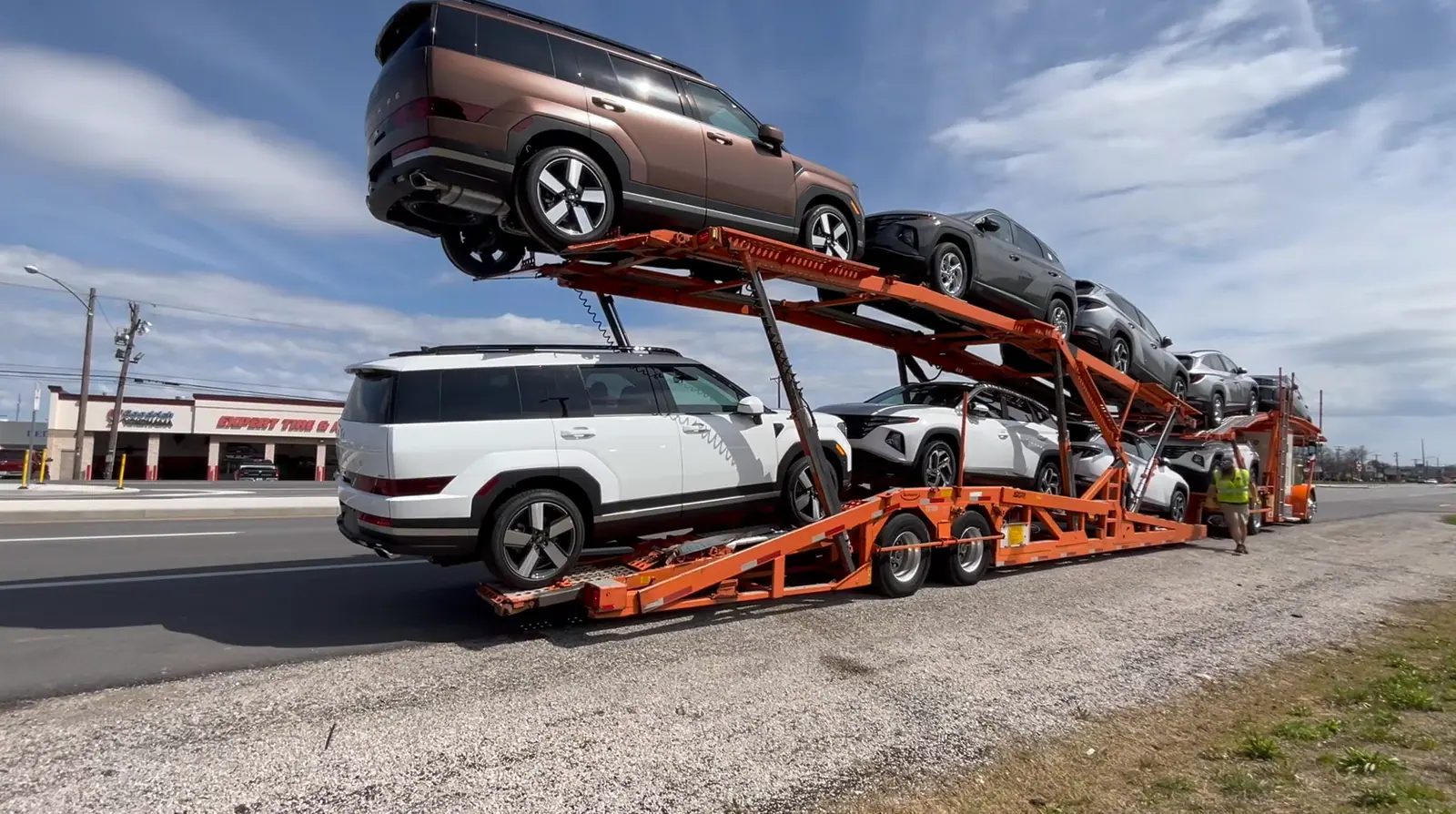
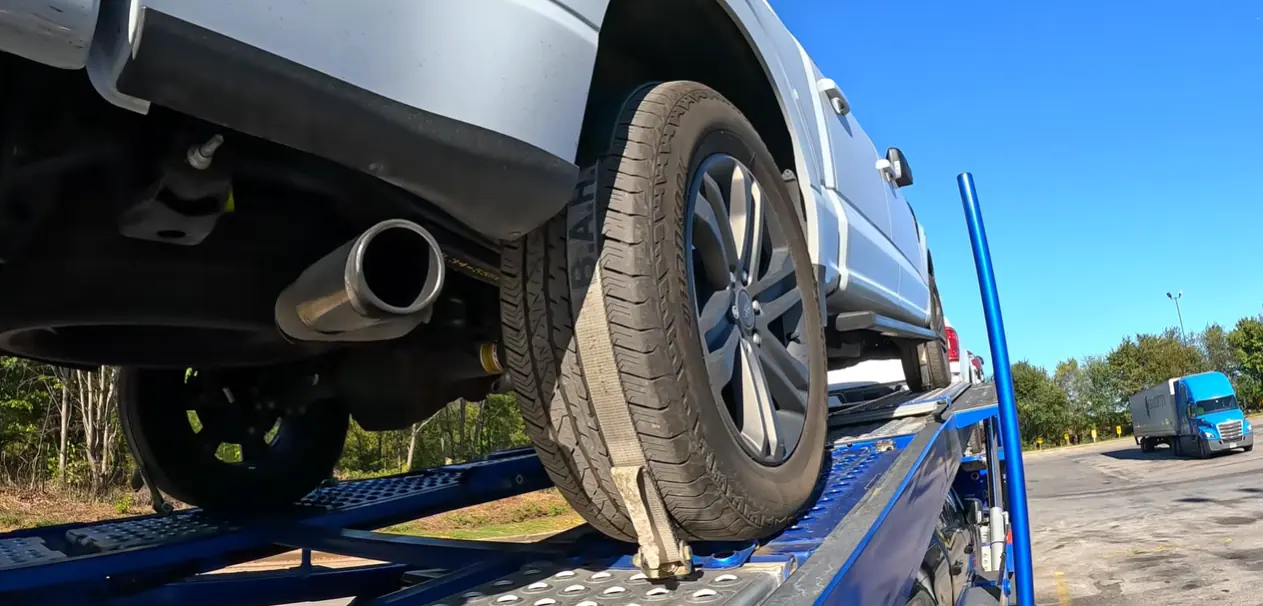
If you've passed a tractor-trailer stacked with cars on two levels, you've seen open car transport. The trailer has no walls or roof. Cars ride on hydraulic decks, strapped or chained down at the wheels, and the rig works its way along a lane picking up and dropping off as it goes. Dealers, rental fleets and manufacturers move most of their inventory this way, which is why there are far more open carriers on the road than any other kind.
That availability is the main reason to choose open. More trucks on more lanes means a wider choice of pickup dates and a lower price than enclosed transport. It suits:
- Daily drivers, family SUVs, pickups and leased cars on a move or a relocation.
- Cars bought online or out of state that need to come home.
- Long hauls where driving yourself means days of hotels, fuel and miles on the odometer.
How an open carrier moves your car
There are two common setups, and we match the rig to the trip:
- The full-size two-level carrier. A tractor pulling a trailer that holds roughly 7–10 cars, with the front of the trailer often extending over the cab. This is the workhorse of long-distance lanes like New York to Florida and California to Texas.
- The smaller wedge or "hotshot" trailer. A heavy-duty pickup towing a two- or three-car trailer. It's handy for shorter runs and tight neighborhoods, and sometimes it's what gets a single car moving quickly.
At pickup the driver inspects the car and marks any existing scratches, dents and chips on the bill of lading. Then the car is driven up the ramps and secured. Where it rides depends on the load plan: heavier vehicles tend to go on the bottom deck, and the driver arranges stops so cars come off in delivery order. You get the bill of lading copy at pickup, and the same document is checked again when the car comes off the trailer.
What drives the price of open transport
An open-carrier quote is really a question of what it takes to get a driver to take your car on their trailer. A spot on a truck heading where your car needs to go is worth what the market will pay for it that week. The main variables:
| Factor | How it moves the price |
|---|---|
| Distance | Longer trips cost more overall, but the cost per mile drops as the distance grows. The fixed work of loading, inspecting and unloading is spread across more miles. |
| Lane | Busy interstate lanes between big metros have plenty of trucks. A pickup two hours off the interstate costs more because the driver gives up time to reach it. |
| Vehicle size and weight | A compact sedan leaves room for more cars on the trailer than a crew-cab pickup does. Trucks are limited by weight as well as deck space. |
| Season | Summer moving season and the snowbird months push demand up on certain lanes. Holiday weeks thin out the number of drivers. |
| Fuel | Diesel is one of a carrier's biggest costs, and rates follow it. |
| Flexibility | A pickup window of several days lets us match your car to a truck already passing by. A single fixed date narrows the field. |
| Condition | A car that doesn't run needs a winch and more handling. See inoperable vehicle transport. |
The quote we give you is all-in for the trip: transport, the carrier's cargo insurance while your car is on the truck, and pickup and delivery at your addresses. For the long version of how car shipping is priced, read our guide to how much it costs to ship a car.
Typical open car transport cost by distance
Market ranges for a standard sedan, by trip length. The per-mile rate falls as the distance grows.
| Distance | Open | Enclosed | Per mile | Transit |
|---|---|---|---|---|
| Under 500 milese.g. Los Angeles to Phoenix | $350–$550 | $500–$850 | $0.95–$1.49 | 1–2 days |
| 500–1,000 milese.g. Houston to Orlando | $600–$925 | $875–$1,425 | $0.62–$0.95 | 2–3 days |
| 1,000–1,500 milese.g. New York to Miami | $675–$1,075 | $975–$1,675 | $0.53–$0.84 | 3–4 days |
| 1,500–2,000 milese.g. Chicago to Phoenix | $825–$1,275 | $1,200–$1,975 | $0.47–$0.73 | 4–5 days |
| 2,000–2,500 milese.g. Dallas to Los Angeles, via San Francisco | $975–$1,525 | $1,425–$2,375 | $0.42–$0.66 | 5–7 days |
| Over 2,500 milese.g. New York to Los Angeles | $1,125–$1,750 | $1,625–$2,725 | $0.40–$0.63 | 6–8 days |
Estimates, not quotes. Ranges reflect publicly advertised rates for a standard sedan on an open carrier as of November 2026. Enclosed transport typically runs about 1.5× the open rate, and SUVs and pickups usually add $100–$200. Your all-in price depends on the exact addresses, the vehicle, the season and carrier availability on your dates. Figures checked November 2026.
Timeline: the pickup window plus days on the road
Open transport time has two parts. The pickup window is how long it takes for a truck on your lane to have room. On busy routes that's often a few days from your first available date; from rural areas it can take longer. Then comes transit. Federal hours-of-service rules cap a driver at 11 hours behind the wheel per shift, and a carrier with other stops typically covers somewhere around 400–500 miles on a good day.
- Under 500 miles: often 1–3 days once the car is loaded.
- Half a country, like Chicago to Florida: commonly 3–5 days.
- Coast to coast, like California to Florida: usually 7–10 days.
Need the car moving sooner? Expedited shipping shortens the wait for pickup. It can't make the truck legally drive more hours.
Getting your car ready for an open carrier
- Wash it a day or two before pickup so existing marks are visible at inspection.
- Take dated photos of all four sides, the roof, the wheels and the odometer.
- Fold in the mirrors and remove anything that could catch the wind: bike racks, loose roof boxes, flags, aftermarket antennas.
- Keep the fuel at about a quarter tank. Fuel is weight, and the driver only needs enough to load and unload.
- Turn off or remove toll transponders, and tell the driver how to disarm any aftermarket alarm.
- Leave the car free of personal items. They aren't covered by the carrier's cargo insurance and add weight the truck has to account for.
Our car shipping prep checklist walks through each step, including how to read the bill of lading.
The honest risk picture
Open transport is safe. The overwhelming majority of cars arrive exactly as they left, apart from a coat of road dust. But it is open, and it helps to know what that means:
- Weather and grime. Rain, sun and, in winter, road spray. A car wash usually fixes it.
- Road debris. A stone chip is possible, as it is on any highway, but uncommon.
- Deck position. The top deck avoids drips from other vehicles, while the bottom deck is more sheltered from the sun. You can request a top-deck spot. It isn't always possible, and if it matters to you, tell us when you book.
If any of that worries you for a particular car, such as a fresh paint job, a matte wrap or a low-slung sports car, that's the case for enclosed. Our open vs enclosed guide helps you decide.
Common questions
Is open car transport safe for a newer car?
Will my car be on the top or bottom deck?
How many cars are on an open carrier?
Can I ship a lifted truck or a lowered car on an open carrier?
Will my car get dirty?
Why is open cheaper than enclosed?
Do I need to be there for pickup and delivery?
Routes where this comes up
All routes- New York to Florida car shippingI-95 · about 3–5 days in transit
- Chicago to Florida car shippingI-65 to I-75 · about 3–6 days in transit
- California to Texas car shippingI-10, or I-40 to Dallas · about 4–7 days in transit
- California to Florida car shippingI-10 (often I-5 or I-40 first from Northern California) · about 7–10 days in transit
Cities we serve
All citiesOften paired with
All services- Enclosed transportWalls, a roof and a smaller load. For the cars you'd rather not expose to a thousand miles of weather, grit and road spray.
- Door-to-door shippingNo terminal to drive to and no lot to collect from. The carrier comes to your address at both ends, or as close as the truck can safely get.
- Expedited shippingWhen the date can't move, we put a stronger offer in front of carriers on your lane so your car gets picked up sooner. Here's what that can and can't do.
- Multi-car shippingTwo cars, three cars, a whole household's worth. Sometimes they belong on one truck and sometimes they don't, and we'll tell you which.
Get your car on the next truck heading your way
Tell us where it is, where it's going and when it's ready. We'll match it to an open carrier on that lane and send one all-in price.