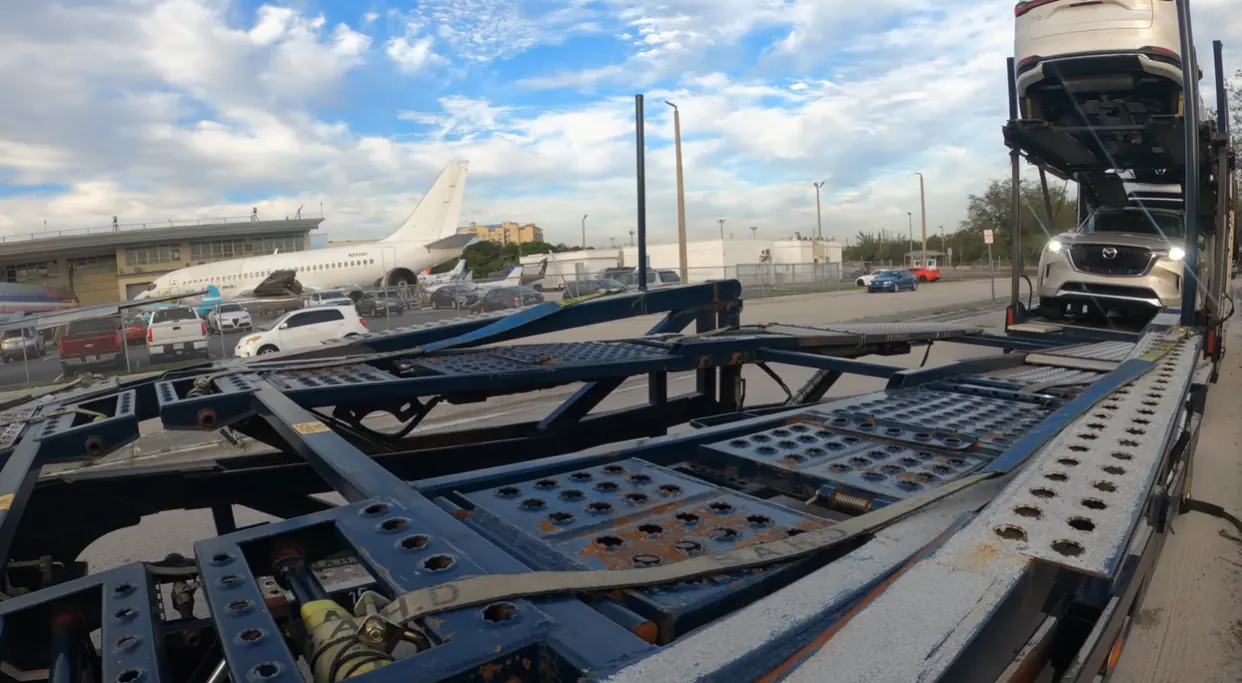
Shipping your car south for the winter comes down to two separate clocks. The first is your car's: as a nonresident's vehicle it can stay in the US for up to a year, duty-free, as long as it isn't sold. The second is yours, and it's more complicated. US visitor rules, an IRS day-count formula and your province's health-coverage limit each measure your time away in a different way.
This guide covers both, in the order you'll need them: the documents the car needs to cross, the day counts that apply to you, when to book, how to prepare the car, and how the spring trip home works. It's written for Canadians heading to Florida, Arizona, Texas and California, which is where nearly all snowbird cars go.
The short version
- Your car may stay in the US for up to one year under HTSUS 9804.00.35, duty-free, but it can't be sold or transferred while it's there.
- Because you aren't crossing with it, the car needs CBP Form 3299, DOT HS-7, EPA 3520-1 and a signed authorization letter, along with copies of your passport and registration.
- Your own limits are separate: US admission (commonly up to six months), the IRS substantial presence test, the US registration rule for stays of 30+ days, and your province's health-coverage rule.
- Book the fall trip in September for October–December pickups, and book the spring return before you leave, because March and April fill just as fast.
- Ship the car empty. A packed trunk is the most common reason a snowbird car gets held at the border.
Two clocks: the car's and yours
If the car is allowed to stay, it doesn't follow that you are. They're separate questions answered by different agencies, and mixing them up is how snowbirds end up with an unexpected tax filing or a gap in health coverage.
| Clock | Who sets it | Limit | What happens if you go over |
|---|---|---|---|
| The car | US Customs and Border Protection | Up to one year from entry, for a nonresident's personal-use vehicle | It needs a formal import, with emissions and safety requirements and possibly duty, or it has to leave |
| Your visit | CBP at your entry | Commonly up to six months for Canadian visitors | Overstays carry immigration consequences; ask CBP before you plan a long stay |
| Your tax status | The IRS substantial presence test | A weighted count of days over three years (see below) | You may be treated as a US tax resident unless you file Form 8840 |
| Your health coverage | Your province | Varies by province | Your provincial coverage can lapse |
The documents your car needs to enter the US
A Canadian resident bringing their own car into the US for a winter is a routine case. The legal basis is HTSUS subheading 9804.00.35, which lets a nonresident bring in a vehicle for personal use without formal entry or duty for up to one year. Because the car arrives on a carrier rather than with you, it needs a small file of paperwork:
| Document | What it does | Who handles it |
|---|---|---|
| CBP Form 3299 | Declares the vehicle as an unaccompanied article entering free of duty. You need it because you're not at the border with the car. | Prepared with you; presented by the carrier |
| DOT Form HS-7 | The NHTSA safety declaration, marked for a nonresident's temporary personal-use import | Prepared with you |
| EPA Form 3520-1 | The emissions declaration, marked for a nonresident importing for personal use | Prepared with you |
| Authorization letter or POA | Lets the carrier (and its customs broker, if it uses one) present the car on your behalf | Signed by the registered owner |
| Passport copy | Shows the owner is a Canadian resident and nonresident of the US | You |
| Registration | Ontario vehicle permit, Quebec SAAQ certificate, BC ICBC registration, etc. | You |
| Lienholder letter | Only if the car is financed or leased: the lender's or lessor's permission for the car to go to the US | Your bank or leasing company |
Our Canada to US car shipping service puts this package together from your scans, so the only originals you deal with are your own signatures. Ask your lender for the lienholder letter the day you book. It's the document most likely to run late.
Your own day counts: the US, the IRS and your province
None of this is about the car, but it decides how long the car is actually useful to you down south, so plan it alongside the shipment.
US admission
Canadian visitors are commonly admitted for up to six months at a time. That's an admission decision CBP makes at entry, not a guaranteed allowance, and it doesn't reset just because you pop back across the border.
Registering a stay of 30 days or more
Since April 2025, Canadians who stay in the US for 30 days or longer and did not receive an I-94 record at entry have had to register with US Citizenship and Immigration Services, generally by filing Form G-325R online. Snowbirds who fly in usually receive an electronic I-94, which counts as registration. The ones caught out tend to be people who drove across a land border. Guidance on edge cases (NEXUS, multiple entries) has been updated more than once, so check CBP and USCIS before you travel.
The IRS substantial presence test
The IRS counts every day you're in the US this year, a third of the days last year, and a sixth of the days the year before. If the total reaches 183 (and you were present at least 31 days this year), you're treated as meeting the substantial presence test. The practical rule of thumb: spending more than about 121 days a year in the US, year after year, is where the math tips over. Most snowbirds in that range file Form 8840, the Closer Connection Exception Statement, to show their real home is in Canada. Talk to a cross-border tax professional if you're anywhere near the line.
Your provincial health coverage
Each province limits how long you can be away and keep your coverage, and the rules differ and change. At the time of writing, Ontario's OHIP allows up to 212 days outside Canada in any 12-month period, and Quebec's RAMQ requires you to be present in Quebec at least 183 days per calendar year. BC, Alberta and the other provinces have their own rules. Check your province's current rule before you set your dates, and remember that provincial plans pay little toward US medical bills, which is why out-of-country medical insurance is a standard part of snowbird planning.
A booking calendar that works
Snowbird traffic is lopsided. Southbound demand builds after Canadian Thanksgiving and peaks in November; northbound peaks in March and April, clustered around Easter. Only part of the car-hauling fleet runs cross-border loads, so those trucks fill first. Working backward from a mid-November flight:
Early September: get your quote
Settle the destination address, the pickup window and open vs enclosed. Ask your lender for the lienholder letter now if you need one.
Late September: book both directions
Book the spring return at the same time. You'll be glad you did in March.
Early October: paperwork
Send passport and registration scans, sign the authorization letter, and confirm insurance coverage in the US for the length of your stay.
Three to seven days before you fly: pickup
The car usually arrives within a few days of you. Typical transit after pickup is 4–7 days to Florida from Ontario or Quebec, and longer to Arizona and California from the East. See how long car shipping takes for why.
Delivery: inspect, then sign
Check the car against the pickup report and note anything new on the bill of lading before you sign it.
Getting the car ready (the snowbird version)
The general checklist is in how to prepare your car for shipping. These are the items specific to a winter away:
- Insurance: call your insurer and confirm the policy covers you in the US for your full stay. Some policies want to know about long absences.
- Registration renewals: if your registration, validation or emissions paperwork comes due while you're away, deal with it before you leave.
- Toll transponders: remove the 407 ETR or other transponder before pickup, or the trip may ring up tolls.
- Maintenance: get the oil change and tire check done at home. A car that's going to sit in Florida heat or Arizona sun benefits from fresh fluids and a battery test.
- Keys: one set to the driver; keep the spare.
- Photos: take date-stamped photos of every panel, the wheels and the odometer on pickup day.
While you're down south
Your car stays on Canadian plates, registration and insurance all winter. Keep copies of its entry paperwork in the glovebox. Two things to avoid: don't sell the car or sign it over to anyone in the US, and don't let one winter stretch past the one-year mark without a plan, because a longer stay means a formal import.
The trip home in spring
Northbound is simpler on paper but tighter on schedule. Canada treats goods coming back into the country as imports, and that includes your own car arriving on a commercial carrier. The carrier reports the vehicle to the Canada Border Services Agency before it arrives. A Canadian-registered car that went south temporarily comes home under its existing registration, without the Registrar of Imported Vehicles process that applies to US-bought cars.
The exact document list depends on your car and how it went south, so we confirm it at booking. The scheduling advice is the same every year: March and April are the northbound rush, and late bookings get the leftover dates. Our US to Canada car shipping page covers the return in detail, and Florida to Toronto covers the busiest return lane.
The snowbird lanes
| Lane | Main corridor | What to know |
|---|---|---|
| Toronto to Florida | I-75, or I-77 to I-95 | The busiest snowbird lane; book early for November |
| Montreal to Florida | I-87 to I-95 | Crosses at Lacolle–Champlain; strong Atlantic-coast demand |
| Ottawa to Florida | I-81 to I-95 or I-75 | Crosses near Prescott or the Thousand Islands |
| Toronto to Arizona | Cross-country to I-10 | Longer haul with fewer trucks; allow more lead time |
| Vancouver to Arizona | I-5 then east | Crosses at Blaine; winter passes can slow inland routes |
| Vancouver to California | I-5 | The most direct cross-border lane on the West Coast |
| Florida to Toronto | I-75 or I-95 north | The spring return; March and April fill fast |
For the full round-trip picture, including destinations like Naples and pickup across the Greater Toronto Area, see our snowbird car shipping service.
Questions readers ask
Can I drive down and ship the car home, or the other way around?
What if I end up staying more than a year?
Do I need my own customs broker?
My spouse and I co-own the car. Who signs?
Written by the Tailwind Auto Transport team. This guide is general information, not legal, tax or immigration advice; rules change, so confirm anything critical with the agency involved.